
The difference in cost between Team Bonding, Team Building, or Team Development
Often, two quotes for a “team-building” program can differ by hundreds, or even thousands, of dollars. In most cases, both providers are pricing honestly; they’re just describing very different kinds of programs.
It is important to understand that corporate engagement programs generally fall into three categories: Team Building, Team Bonding and Team Development. Each is designed for a different objective, each involves different levels of complexity, and each is priced accordingly. Knowing which category a quote belongs to is the best way to compare options fairly.
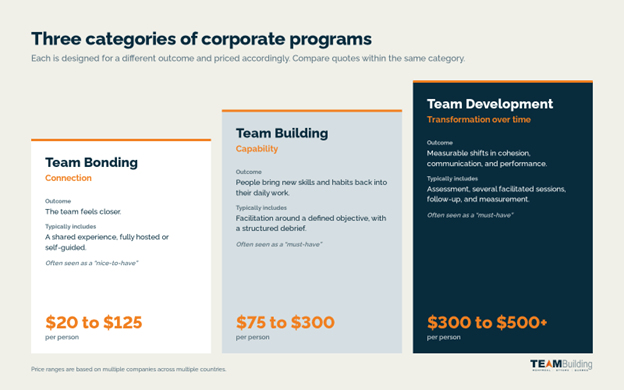
Team Bonding: Connection
Team bonding brings people together through a shared experience. It builds rapport and creates memories. The outcome is relational: the team feels closer.
Organizations often treat team bonding as a “nice-to-have.” It is valuable for morale, and it is often among the first budget lines reconsidered when money is tight.
Team bonding formats vary widely. Some are fully hosted, with the provider handling logistics from start to finish. Others are self-guided, with the client taking care of the venue, transportation, food, or coordination. How much the provider hosts and handles is one of the main reasons team bonding prices can be lower.
Examples: escape rooms, bowling, cooking classes, scavenger hunts, trivia nights, social outings.
Typical price range: $20 to $125 per person.
Team Building: Capability
Team building is about accomplishing something together while developing specific skills, such as communication, decision-making, trust, collaboration across silos, and working under pressure. The outcome is behavioural: people bring new skills and habits back into their day-to-day work.
Organizations should treat team building as a “must-have,” because it addresses how the team performs, not only how it feels.
A team-building program typically includes facilitation designed around a defined objective, guidance before the day, and a structured debrief that connects the experience to the team’s real work.
Examples: facilitated challenge-based programs with structured debriefs, problem-solving simulations, collaborative build projects tied to a defined objective, social giveback initiatives.
Typical price range: $75 to $300 per person.
Team Development: Transformation over time
Team development works across multiple touchpoints over weeks or months. It typically combines diagnostic assessment, facilitated sessions, structured follow-up, and measurement before and after. The outcome is organizational: measurable shifts in cohesion, communication, and performance.
Like team building, team development is usually treated as a “must-have,” often tied to a specific moment such as a restructuring, new leadership, or a merger.
Examples: multi-session programs built on team or personality assessments, leadership development series, team effectiveness programs with pre- and post-measurement.
Typical price range: $300 to $500+ per person.
*Price ranges are based on multiple companies across multiple countries.
How to compare quotes like-for-like
Three checks make any comparison clearer.
Check what is included. A program described as team building should include facilitation designed around an objective and a debrief that connects the experience to work. A program described as team development should include assessment, follow-up, and measurement. If those elements are missing, the program likely belongs to a different category, despite what it is called.
Check where the price sits. A quote well below its category’s typical range often belongs to the category below it. A $50 outing and a $200 facilitated team building program are different purchases, even when both carry the same label. A team building program priced like an afternoon outing is usually team bonding. A team development program priced like a single workshop is usually team building. A quote above the range may reflect factors such as the provider’s experience and reputation, or additional components that may or may not be of value to the client.
Check how it is promoted. An authentic team-building program leads with the outcome it is designed to produce. Enjoyment is part of how it works, but it is never the main promise. When fun is the headline, the program is most likely team bonding presented as team building.
Questions worth asking any provider:
- What outcome is this program designed to produce?
- What happens before the program, and what happens after?
- Who designs and facilitates it, and what is their background and experience?
- What is included, and what will we need to handle ourselves?
- How will we know whether it worked?
What moves the price within a category
- Group size. Larger groups need more facilitators and logistics, though the cost per person often drops as the group grows.
- Duration. A two-hour program and a full-day offsite involve very different design and delivery.
- Format. Virtual programs usually sit at the lower end of a range. In-person programs can involve venue, travel, and catering, and overnight retreats or premium venues can push any category above its typical range.
- Hosting and logistics. A fully hosted program costs more than one where the client handles parts of the planning.
- Customization. A program designed around a team’s specific situation takes more preparation than a standard format.
- Location. Venue choice and travel distance both play a part.
Training tax credits
Depending on where an organization operates, training credits may be available to help offset the cost of skills-focused programs. In Quebec, for example, the training tax credit may allow eligible organizations to count structured training toward their training obligations. Programs designed around skills development, which typically means team building and team development, are the most likely to qualify, and working with an accredited training provider is often part of the picture. Eligibility depends on the organization, the program, and the jurisdiction. In Quebec, some organizations, including non-profits and most public bodies, are generally not eligible. Confirming eligibility before committing is the best way to know where you stand.
About TBMOQ
Team Building Montréal has designed and facilitated programs for more than 3,000 teams since 1998, across all three categories. Every program is designed by educators, and TBMOQ is accredited by Emploi-Québec as a training provider. Each engagement starts with the question of why, so the program fits what the team actually needs.