
Case study: How the COC used the Extraordinary Puzzle Challenge to unite athletes towards a common goal
Ahead of the Tokyo Games, the Canadian Olympic Committee (COC) invited TBMOQ to prepare a group of 250 athletes and coaches across dozens of sports.
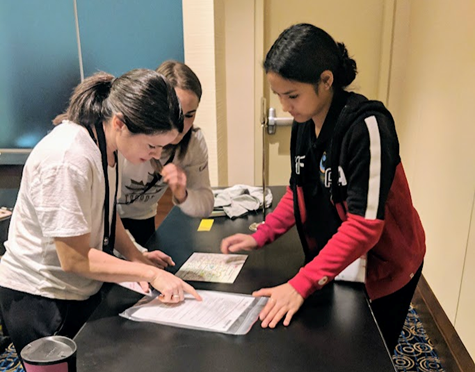
At TBMOQ, every engagement starts with one question: why this program, why now? For the COC, the answer went beyond team bonding. The goal was for athletes competing in entirely different sports to feel like one team under one flag. No matter the sport, athletes needed to be able to approach one another, motivate each other, share best practices, and be present for one another throughout the Olympic experience.
The Extraordinary Puzzle Challenge brings a large-scale puzzle together through mixed sub-groups working in parallel, each responsible for a piece of a larger whole. TBMOQ customized the format around the COC’s goal in two specific ways. First, the puzzle imagery was pulled directly from the philosophy the COC was applying at the time. Second, sub-groups were deliberately mixed across sports, so athletes worked side by side with teammates they would not otherwise train or compete with. COC’s own team messages were embedded directly into the puzzle pieces, so the act of assembling the puzzle became an act of assembling the message itself.
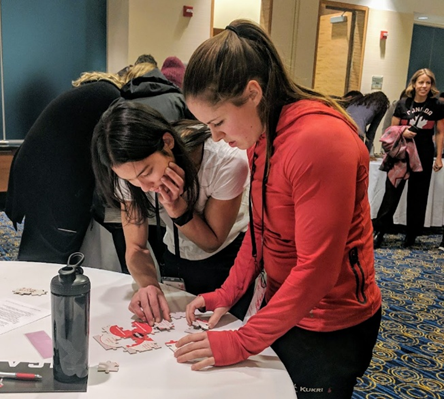
The challenge highlighted a familiar tension. Under time pressure, several sub-groups shifted into competitive mode, prioritizing speed over care. Pieces were forced into slots that did not fit, and what looked like progress on the surface created problems elsewhere in the puzzle. That moment of visible chaos became the turning point of the session.
Here’s why. Each puzzle piece was double-sided, one side forming the visual image, the other carrying a fragment of a shared message. The message stayed hidden until every sub-group’s small puzzle was correctly assembled into the larger one and the group turned it over together. A puzzle rushed without process could look complete on the surface while the message underneath came out scrambled. Only the groups that had followed the process revealed it intact, a direct parallel to the athletes’ own preparation. A team can look physically ready and still fall short underneath, not yet mentally prepared to share best practices, notice a teammate who needs encouragement, or extend that support beyond their own sport to Team Canada as a whole.
In the debrief that followed, the group worked through what had happened, the cost of prioritizing task completion over collaboration, and what shifts when a team manages resources and shares information instead. That shift did not stay in the room. In the very next challenge of the day, the group visibly carried the collaborative behaviour forward.
About TBMOQ
Team Building Montréal, Ottawa & Québec (TBMOQ) has designed and delivered corporate team experiences since 1998. Our Transformational Fun methodology moves organizations through three stages, Team Bonding, Team Building, and Team Development, strengthening connection, effectiveness, and capability. TBMOQ has worked with organizations including the Canadian Olympic Committee, Desjardins, Hydro-Québec, Google, Air Canada, RBC, and Bell to create memorable, results-driven programs.
Learn more at tbmoq.ca or follow us on LinkedIn for more insights.