

Two summers ago, the Montreal Canadiens were mid-rebuild, stockpiling draft picks and bottoming out in the standings. Last spring, this space charted how that young roster moved through Tuckman’s Phases of Team Development over the course of the 2024-25 season: forming, storming, re-forming around Patrik Laine’s addition, norming, and ultimately performing their way into the playoffs as the eighth and final seed in the East, where they were eliminated in the first round by the Washington Capitals.
That first playoff appearance was supposed to be the reward for years of patient team building. What followed this past season was something else entirely: proof of what a team looks like once it has already found its form.
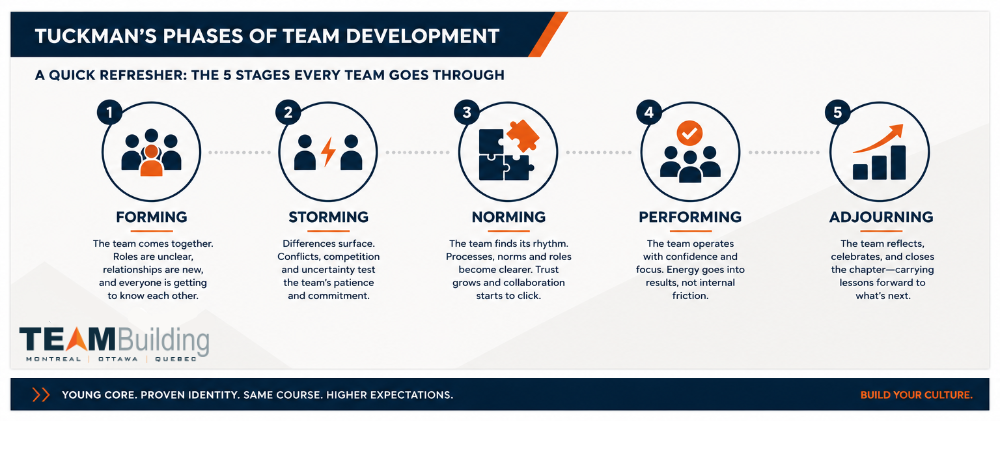
From norming to performing, and staying there
The 2025-26 Canadiens didn’t need a training camp to reset the roles established the year before. With only a few additions in Noah Dobson and Zach Bolduc, the team spent the season building on norms rather than establishing them from scratch. The result was a 48-24-10 record, 106 points, and the club’s best regular-season point total in over a decade.
More importantly, Montreal didn’t just make the playoffs. They won there. A seven-game chess-match victory over the Tampa Bay Lightning in round one was followed by another gruelling seven-game character-building win over Buffalo, sending the Canadiens to the Eastern Conference Final for the first time since 2014[1], where they were eventually stopped by the eventual Cup Champion Carolina Hurricanes. It was a run built on the very attributes Tuckman assigns to a performing team: clear roles, smooth processes, and a group operating at a level that no longer needed to think about how to work together, only about the task in front of it.
According to Team Building Montreal’s president and lead facilitator, Marc Merulla, that distinction matters more than the final result.
“Making the playoffs proves a team has found its footing. Winning multiple rounds proves it’s performing,” he says. “The Canadiens didn’t just qualify for the post-season last spring. They operated inside it the way a high-functioning team operates inside a crisis: without losing their identity.”
Moving forward while standing still
Every team that falls short of their ultimate goal faces the same question at the end of a cycle: what do we change? For most organizations, especially ones that came as close as Montreal did, the instinct is to make wholesale changes or at the very least tweak the roster. Across the league this off-season, contenders and rebuilders alike reshuffled rosters, chased big names in free agency, and absorbed the disruption that comes with it. From Tuckman’s point of view, this is akin to restarting at the Forming stage.
Montreal, by contrast, has been almost eerily quiet. General manager Kent Hughes used the summer to lock up the pieces already in place rather than acquire new ones: an eight-year extension for Ivan Demidov and a three-year deal for Jakub Dobes, and even retaining Kirby Dach for another year. The only subtractions of note were long-time winger Brendan Gallagher, traded to Vancouver, and the departure of Patrik Laine. Neither player was called upon at crunch time last season. Beyond that, the roster that reached the Conference Final is, for all intents and purposes, the roster that will open the new season.
Youngest roster, biggest advantage
What makes Montreal’s restraint even more notable is who they’re staying the course with. For the third consecutive season, the Canadiens will open the year as the youngest team in the NHL by average age, a distinction that, on paper, should work against a team hoping to contend. Young rosters are supposed to take time to gel, to make mistakes, to need veteran hands to guide them through adversity.
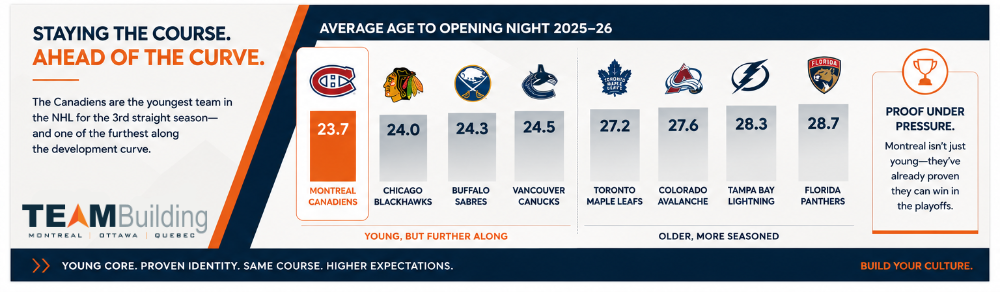
Except this group has already been through that process. Unlike most of the league’s other young rosters (teams like Chicago, Buffalo or Vancouver, also low on the age curve but not as far along in their development), the Canadiens spent last spring proving their identity under playoff pressure, twice, in seven-game series. They are a rare case of a team that is simultaneously the youngest in the league and one of the furthest along the development curve.
“That combination is what should excite Habs fans heading into this season,” says Merulla. “Normally when people talk about a young core, they’re describing potential, what a team could become. With this group, the potential has already converted into performance. They’re not hoping to figure out how to win together. They already know how, and they get to keep doing it with players who are, in most cases, still improving individually.”
Consternation, and why it may be overstated
There’s understandable anxiety among fans watching divisional and conference rivals retool aggressively this summer while Montreal stood mostly still. It’s a natural reaction. Activity looks like ambition, and quiet often gets mistaken for complacency. But Tuckman’s model is a reminder that every roster shake-up elsewhere on the ice comes with a hidden cost: those teams are, to varying degrees, re-entering the Forming and Storming stages, integrating new pieces, and re-establishing roles, even if the names on their roster look more impressive on paper. Practically speaking, this usually results in some growing pains at the beginning as roles are cemented and systems are absorbed. Conversely, the Canadiens should expect to hit the ground running as the season begins and should realistically be able to take advantage of teams still working toward the norming and performing stage. As they say, two points in November are worth the same as two points in April.
When training camp opens, there will be no major new personalities to integrate, no revamped lines to workshop, no unclear roles to sort out. The habits, chemistry and trust built over three full seasons (through a rebuild, a breakthrough, and a Conference Final run) carry forward untouched.
“The team that changes the least after a good season is usually the team most confident in what it built,” Merulla adds. “Kent Hughes and this coaching staff clearly believe they already have a performing team. The question this year isn’t whether the Canadiens can find their form. It’s how far a team can go once it no longer has to.”
Beyond the rink
None of this is unique to hockey. Every organization eventually faces the same fork the Canadiens found this summer: a team hits its stride, and someone in the room suggests a shake-up anyway, mistaking motion for progress. Tuckman’s model was built for boardrooms and project teams long before anyone applied it to a locker room, and the lesson travels in both directions. A sales team that just had its best quarter, a leadership group that just navigated a merger, a department that finally has the right people in the right seats — the instinct to tinker is strongest exactly when it’s least warranted.
“Leaders love the feeling of doing something,” says Merulla. “But a team that has already reached performing doesn’t need a new plan — it needs the discipline to protect what got it there. The Canadiens’ off-season is a case study in that discipline: knowing the difference between a team that needs to be rebuilt and one that just needs to be trusted.”
ABOUT TEAM BUILDING MONTREAL
Team Building Montreal is a bilingual, Emploi-Québec accredited training organization that has helped more than 3,000 teams work better together since 1998. Our programs are designed by educators to produce measurable shifts in how teams communicate, collaborate, and trust one another, for clients ranging from 30-person firms to the Canadian Olympic Committee. So we know a little about what it takes for elite teams to perform under pressure. Which brings us to the one program sitting at the top of our bucket list: the annual team-building program for the Montreal Canadiens. Nick, Kent, Geoff, Martin, the invitation is open. Learn more.
[1] In 2021 the Canadiens actually advanced to the Western Conference Final, and then the Stanley Cup Finals