
Watching the Montreal Canadiens dynamic season has been a fascinating look at team building, culture building and the phases of team development. After three years of rebuilding, finishing at the bottom of the standings and acquiring high draft picks, this season was poised to be the first where the seeds that had been planted would finally begin to bear fruit.
The concept of Tuckman’s Phases of Team Development describes how teams (be they work, sports or other) typically evolve. This article explores these stages and how they apply to the 2024-2025 season.
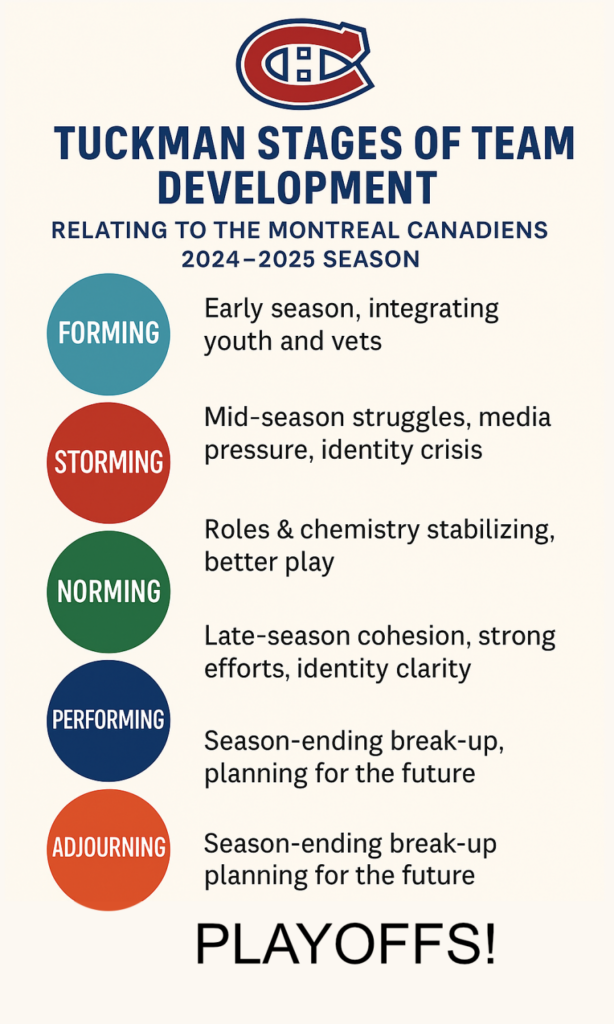
Forming
This is the beginning of the process as a team comes together for the first time or must integrate a new member or deal with the departure of a member. This phase is typically defined by little agreement, unclear purpose and roles and requires a lot of guidance and direction.
For the Canadiens, this was training camp originally. Some new players, such as Patrick Laine, Lane Hutson and Emil Heineman needed to be integrated into the fold of established veterans and 2nd and 3rd year players. The injuries to Laine and David Reinbacher during the pre-season further muddied the roles and forced the team to adapt from their original plan. The result? After 10 games, the Habitants were ranked 24th in the league, stumbling to a 4-5-1 record.
Storming: Conflict and competition emerge as individuals assert their opinions. Tensions can rise over goals, roles, and responsibilities. This is often the most challenging phase.
It was the month of November, just before the return of Patrick Laine, that things were the bleakest. A 4-8 record and a constant carousel of defensive pairings led to much frustration among the players who expected more. After 20 games, the Canadiens were tied for last in the league with just 16 pts. The players did not seem to comprehend the defensive system the coaching staff wanted them to play; they had allowed 21 more goals than they had scored, and fans and media were bracing for another year as an NHL doormat. Reintegrating Kirby Dach as the second-line centre proved more difficult than hoped.
According to Team Building Montreal’s president and lead facilitator, Marc Merulla, the Storming stage is the most critical. “The longer a team ignores it, hoping it will go away or ‘work itself out’, the further they stray from attaining the attributes required to be a high-performing team. Each storm a team navigates brings new resilience and adds to their capabilities to quickly adapt to change and navigate future storms.”
Forming again…
Unfortunately, the stages are not necessarily linear, and any changes to the team mean a return to step 1, reestablishing roles, and integrating new team members.
On December 3rd, Patrick Laine made his surprise return to the lineup. Originally, it was feared his entire season was compromised, and the team had to change their original plans and slot players that had been expected to play lesser roles, or even play on the minor league team, into his place. His addition to the lineup meant reintegrating a major component to the lineup as he was inserted on the second line and the first power-play unit. The ripple effect meant some players received less ice time and others were demoted. A new norm needed to be established and new roles accepted. Fortunately, the work done in the first twenty games did not go to waste, and the Forming and Storming stages were transcended rather quickly. Later in the month, one of the young defensemen who had been rotating in and out of the lineup was moved in favour of Alex Carrier, a more established defenseman. This move solidified roles and defensive pairings. The final piece of the puzzle, a new backup goaltender, was added on December 28th, and the season began to turn.
Norming
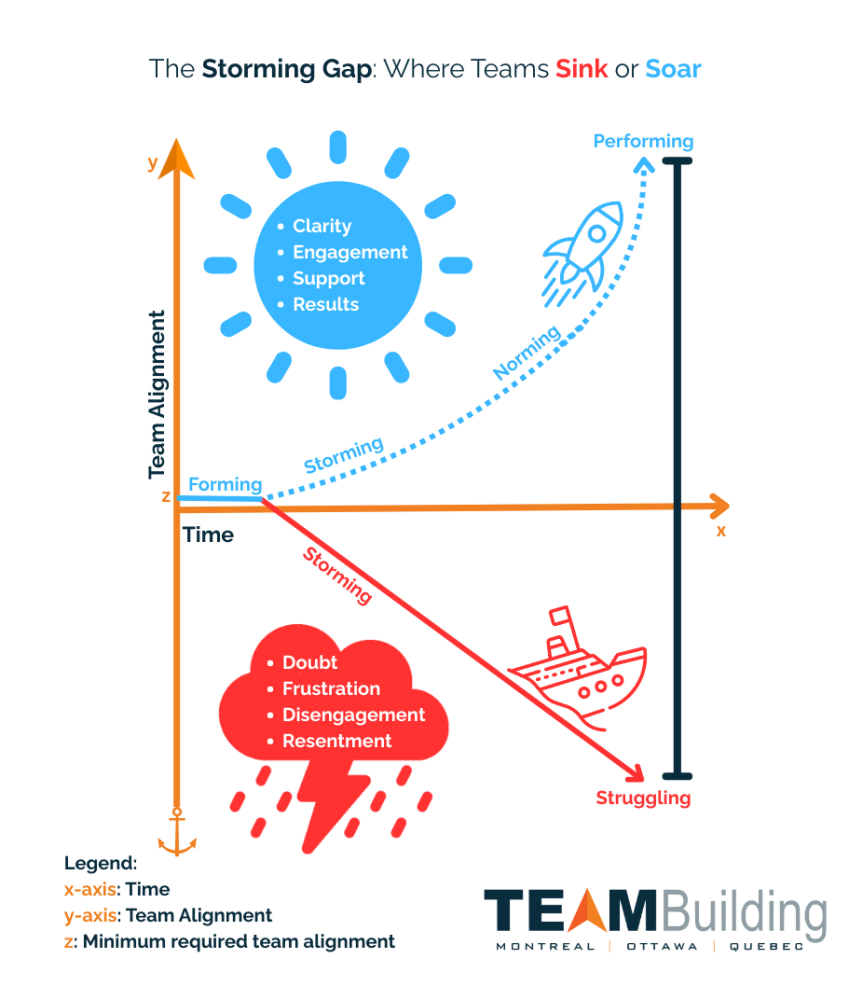
The team begins to resolve differences, establish norms, and develop stronger relationships. There’s more cohesion and cooperation.
With roles accepted and established, defensive systems understood and confidence growing, the Canadiens began a streak that saw them defeat some of the strongest teams in the league, including a stretch that saw them win against the last four Stanley Cup champions. Suddenly, the team was achieving their objective to be “in the mix” to make the postseason.
Performing
The team functions effectively toward achieving goals. Roles are clear, processes are smooth, and the group is highly productive.
After the break for the Four Nations Face-Off in February, 26 games remained, and Les Glorieux sat 6 points back of the final playoff position. A decision by management needed to be made with respect to the trade deadline and what to do with the squad.
General Manager Kent Hughes was tasked with a decision: jettisoning their upcoming free agents for future draft picks and planning for the future, trading some of their own draft picks for other teams’ veterans or simply standing pat with what they had.
Option 1 would essentially admit that they would fail at their goal to make the playoffs, and they would need to start again next season, hopefully with new and better team members.
Option 2 would risk messing with team chemistry and thus revert the team to the Forming stage. New team members could eventually help, but would they be able to integrate these members and traverse the stages of team development in time to achieve their goal?
“Most teams default to the option of making trades,” notes Merulla. “It’s what has become an accepted ‘norm’ in professional sports as some teams make a run for the playoffs while others resign and lick their wounds in preparation for next season,” he adds. “The Habs didn’t take this traditional route. In an exciting twist, they stayed the course with the players and culture they worked so hard to build, even though their chances of making the playoffs were a mere 2%!”
It was during the break that Team Captain Nick Suzuki met with management and pleaded with them not to make any changes to the team. Confident in his team, Suzuki felt they had the right combination of elements to lead them to their objective.
With roles established and the other stages behind them, the Canadiens entered the final stretch of the season performing like they hadn’t all season. Five straight wins after the break and a six-game winning streak in April combined for a 15-5-6 record, just good enough for the team to occupy the final wild-card position and qualify for the Stanley Cup Playoffs.
“Here’s an important component to highlight,” says Merulla. “They didn’t start the year by saying this is our drive for number 25! To win their 25th Stanley Cup in franchise history, they first had to be “in the mix.” To get there, they had to win one game at a time. Win or lose, they committed to learning and improving, thus increasing their chances of being in the mix.” Merulla explains. “When they faced doubt, they addressed it. They didn’t panic and make a bunch of changes. They didn’t undermine all the progress they had made. They built their team culture with intent and stuck with it. Now they can focus on their new goal, which is to win 16 games before the end of the playoffs!”
Adjourning
The team disbands after the project ends. This stage involves reflection, celebration, and sometimes a sense of loss.
With the NHL regular season complete, the team would normally be entering the Adjourning phase. New records and personal bests were achieved, new players were added to the team, and the goal of making the playoffs was accomplished. But with the start of the playoffs imminent, the Montreal Canadiens must now quickly navigate through the Forming, Storming, and Norming stages to quickly perform as they attempt to reach their new objective – their 25th Stanley Cup! No doubt, the continuity of team members and established roles will allow them to transition through the stages more quickly and efficiently than they did before.
“This team has character, commitment, and an unwavering belief in themselves!” exclaims Merulla when asked what he likes best about La Saint-Flannel of 2024-2025. “They also have support.” He continues. “The players support each other on and off the ice. The coaching staff and team management support the players by listening to them and taking into consideration their input, respecting their experience, and understanding what motivates them. This bidirectional communication that transcends traditional hierarchy is inspirational!”