
The Colours Behind Our Team
By Marc Merulla
Who on your team are you avoiding today?
You know the one. You can already hear their pushback before you open your mouth. So you put off the conversation, or you find a way around them.
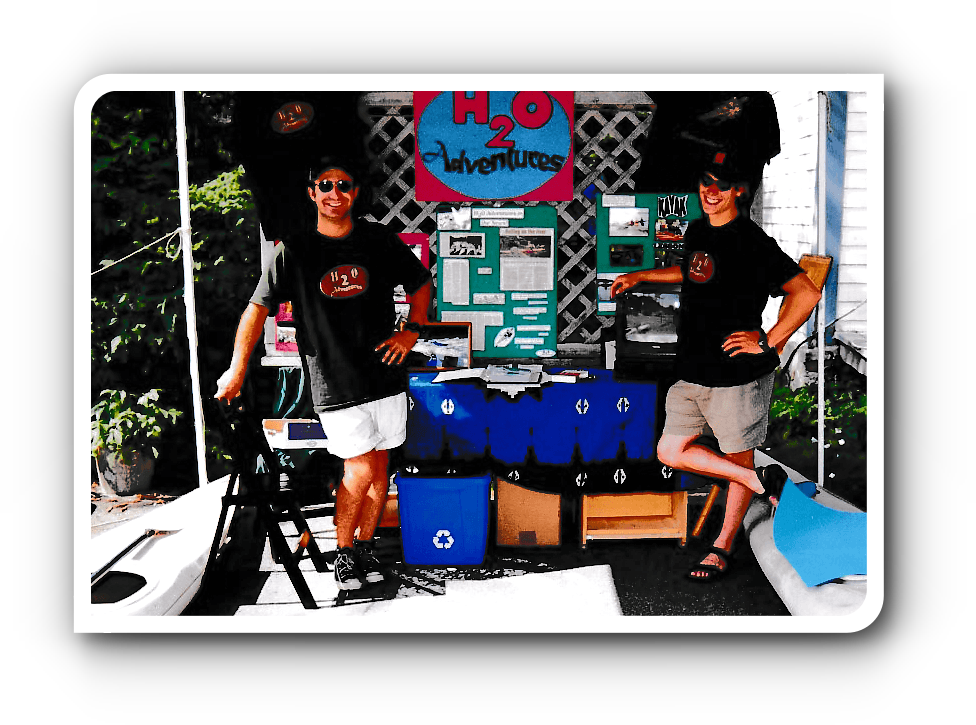
I met my business partner in high school, in 1985. A decade later, we built a company together. And for a long time, we argued, and not the constructive kind.
The arguments were regular, and they almost always came back to the same things: money, resources, and risk. Whenever I wanted to try something new, his answer started with “yeah, but… What will it cost? Who is going to do the work? Is there a better way?” It would drive me up the wall. And I know I drove him just as crazy, coming back with yet another “great idea”. The debates turned into a contest of egos. Each of us was convinced the other simply didn’t get it.
In 2016, he and I went through Dynamix Team Performance. Dynamix is a team development program built on a psychometric assessment that shows how each person prefers to communicate, using four colours. It turned out to be one of the biggest moments of clarity in our company.
Complete opposites
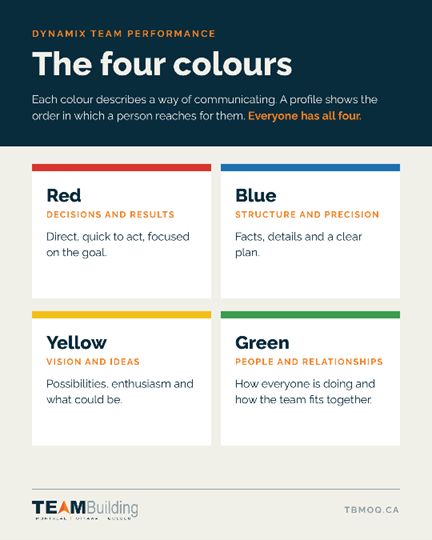
Our profiles came back close to mirror images. I lead with Yellow, then Green. Vision, ideas and relationships come naturally to me. He leads with Blue and Red. He reaches first for precision, structure, and decisions.
Suddenly the arguments made sense. For years, we had been treating our differences as the problem. Looking at the profiles side by side, we could see that those same differences were the reason the company worked at all. Where I see the possibility, he sees what it will take to deliver it.
It also changed how I heard his questions. What will it cost? Who is going to do the work? Is there a better way? For years, I heard pushback. Today I hear him challenging my thinking. He does not need to have the answers to ask the questions. The questions make sure we have thought everything through before we commit. And it works both ways: my ideas challenge his thinking too.
Those arguments also had a cost, and it depended on who you asked. For me, every debate showed up as a cost: lost time and missed opportunities. For him, the same debate showed up as a saving, because it kept money from going into an idea without a proper plan. Both arguments were legitimate.
Each of us was right about half of it. Where we went wrong was thinking our half was the whole picture. The best decision for the company was a plan that addressed both concerns. When we find that plan, we go in together, with clarity and confidence.
Without getting too Jerry Maguire about it, we realized that day that we complete each other. That decision changed how we talk. Adapting to each other still takes real effort, on both sides, but the rewards far outweigh it. And through the help of Dynamix, we learned how to better communicate with each other and how the other one prefers to receive feedback.
MARCH 2020
When both halves mattered
A project manager who worked with us years ago once summed up my partner’s caution about spending:
“[He] acts as if the phone is suddenly going to stop ringing and we’ll have no clients… that will never happen!”
Then came March 2020 and the worldwide COVID19 pandemic. Our calendar was wiped clean, and we had to refund all our clients.
Before any government subsidy was even announced, we had committed to keeping our entire staff employed. The financial buffer he had insisted on is what let us make that promise.
That buffer also gave us room to do what I do best: try something new. From there, we developed a series of virtual programs for remote teams, and they changed the direction of the company. The financial return from those programs has far surpassed the savings we put on the line in March 2020. His caution kept us standing. My optimism, and my attention to what our staff and our clients needed, gave us the confidence to push forward.
Knowing is only half of it
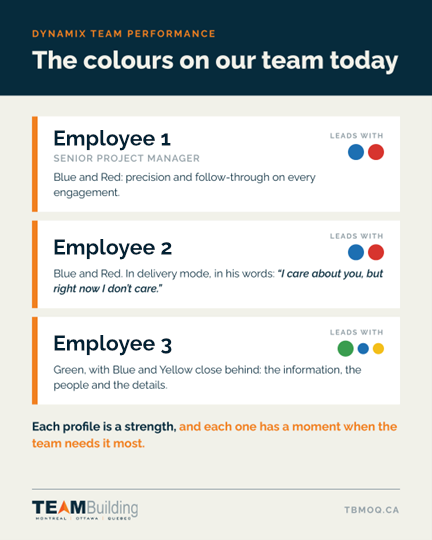
Here is the part I find hardest to admit.
When you know someone well, you know exactly how to say something so they will hear it and want to work with you. You also know exactly what to say to get a rise out of them.
And sometimes, out of frustration, or if I am being candid, out of laziness, we choose the second option. In those moments, we say the thing we know will rub the other person the wrong way, and then act surprised when it backfires.
There is a third option, and it is the most common one: we avoid the conversation altogether. Avoiding feels safer in the moment, and the cost keeps growing. The decision gets made with half the picture. The concern that was never raised shows up later, when it is harder and more expensive to fix. And the friction stays, so the next conversation is even harder to start.
From participant to facilitator
That 2016 session had such an impact on me that when I was invited to become a Dynamix facilitator, I jumped at the opportunity. Today I am certified, and I deliver Dynamix to our clients’ teams.
The work starts the same way it started for us. Each person completes the assessment and discovers which colours they lead with. Then the team looks at those profiles together, and the conversation shifts from who is right to how each person prefers to communicate.
So, who on your team are you avoiding today?
Here is what Dynamix taught us about the other person.
- The friction has a reason. They likely lead with the colours you reach for least. The clash comes from how each of you prefers to communicate.
- They see what you miss. We each saw half of the picture. Our best decisions came from a plan that answered both of our concerns.
- Avoiding them has a cost. Each conversation you put off keeps the friction in place and leaves their view out of your decisions. Learning how they prefer to communicate makes that conversation much easier to start.
Start that conversation this week and pay attention to how they prefer to communicate.
If one of those conversations is on your mind, tell us what your team is working through. I would like to hear about it.
About TBMOQ
Team Building Montréal, Ottawa & Québec (TBMOQ) has designed and delivered corporate team experiences since 1998. Our Transformational Fun methodology moves organizations through three stages: Team Bonding, Team Building, and Team Development, strengthening connection, effectiveness, and capability. TBMOQ has worked with organizations including the Canadian Olympic Committee, Desjardins, Hydro-Québec, Google, Air Canada, RBC, and Bell to create memorable, results-driven programs.
Learn more at tbmoq.ca or follow us on LinkedIn for more insights.